WEDNESDAY 18 JUNE
Before visiting the Peugeot car museum on Wednesday we had to do some boat travel
planning. We’ve had an outline plan that gets us back to the UK in time for
family holidays in August, but we’ve added a spanner in the works as we also
want to pop back for a long weekend at the beginning of July meaning we need to
find somewhere to leave the boat while we go back. There didn’t
seem to be many places between where we are now and Basel where we’ll start our
journey down the Rhine. Other things to throw into the mix were moving the car
as well as water stops and places to get fuel and food.
After a few phone calls, studying maps and researching bus and train timetables we came up with a detailed plan and booked into a port by the Rhine
outside Basel for when we go back for the weekend. We’ve agreed with the port
that we’ll leave the car with them while we head downriver to Strasbourg with a
detour to Colmar for a few days. When we reach Strasbourg, we’ll retrieve the
car and move it to where we’ll leave the boat in August. We started near Nancy in
early April and have followed the purple line to Montbéliard where we are now.
Over the next couple of weeks we’ll head along the blue line to the German
border where we’ll leave the boat to go home for the long weekend. When we return
we’ll complete the circle by following the rest of the blue line back to where
we started with a detour of a few days into Colmar.

To put the distances in context, the complete journey is just
over 900 km and we’ve already covered 540 km. In terms of locks there are
313 for the whole trip and we’ve been through 2/3rd of them.
Once we’d finished planning, we went to visit the Peugeot
museum in town. It was housed in a modern building in the area where the
company has an extensive range of factories. The area is called Sochaux and the
3008 and 5008 models are currently produced there as well as the Citroën DS5.
The museum is laid out in chronological order, and it was interesting to see
how the early cars were little more than horse drawn carriages with an
engine plonked at the front. Neither of us had consciously realised the
connection previously; this photo is meant to capture that connection.

Before going around the car exhibits, we followed those
showing other products produced by the Peugeot family. We learnt so much about
Peugeot and its history having always thought that the company only produced motorbikes,
cars and trucks.
In 1810 four Peugeot brothers founded the company starting
with steel production which expanded into cotton and textiles based in this
area of France which was ideal for building mills to harness waterpower. By the
early 1830s the company were also producing spinning spindles and looms. In 1840
they manufactured coffee grinders producing 1,000 units a day during the second
half of the 19th century. 1852 saw an expansion into saw blades and
crinoline cages which are clearly similar designs. Although we knew what
crinolines were, we’d never heard of crinoline cages and by 1858 they were producing
25,000 a month. Another innovation was in 1867 when the company started manufacturing sewing
machines.
Neither had we known that Peugeot produced aviation engines.
They started in 1905 powering airships then Blériot planes using seven-cylinder
rotary engines. They switched to bomb casings production for WWI and then back
into aeronautics, powering Voisin planes amongst other brands until the 1929
financial crash. They also manufactured marine engines during the same period. To
us, one of the most surprising of their products, other than crinoline cages, was
radios.

The company continued to expand, manufacturing kitchen
products from salt and pepper mills through irons and toasters to food
processors and hoovers, still making many of these products today. Of course,
there were many cars on display from the late 1800s up to the modern day. There
were also sections on their involvement in F1, rallying, sports
car racing and concept cars.

Not only were we amazed at the range and variety of products we found it incredible that so many cars from the early day had been preserved including over 20 in the 1905-18 section.

THURSDAY 19 JUNE
Before leaving Montbéliard we wanted to visit the science
park which was only a five minute walk away from the port. We left before 8.00
as we wanted get back to have a morning cruise before the heat of the day. I
have to admit that we didn’t understand a lot of what we saw. We could see that
this was a pendulum clock as the long pendulum was hanging from the apex and it
was swinging from side to side, but we couldn’t tell the time from it.
Apparently, the plane of the swing slowly moves because of the earth’s rotation
meaning that it can tell more than the time of day.

This one was easy as we could see it was a bronze of an ant…
 |
…but we had no idea of what either of these were:


In the centre of the park was a maze but it wasn’t obvious
what the scientific connection was. We thought it may have been used to
demonstrate to school children how one of the maze solving theories works.

As we set about leaving when we got back to the boat, we
noticed that firemen had turned up at the other end of the port to do some
demonstrations to schoolchildren. These demonstrations included pumping great sprays
of water across the canal and as we were going to be heading in that direction
we hoped they’d see us coming.

The pompiers were also taking half a dozen children out at a
time on a RIB which they seemed to be enjoying especially as they were making a
large wake with the speed they were travelling at.
Soon after leaving the first lock, I remarked to Karen about
how much wider the canal was compared with normal French canals. She
immediately pointed out that were travelling on a section of the river Allan!

This was the stretch alongside which the vast Peugeot
complex was situated but we could hardly see anything of it because of the tall
trees lining the river. What we did see was a heron-like bird but was shorter
and fatter. I sent a picture to a birder friend who said it was a night heron.
I had noticed that our Merlin app has been recording night herons but it was
the first time we’d seen one.
Just before the final lock we were back on the canal proper
and had to make a sharp left turn at an old junction where a disused branch
joined the main canal. In the corner was a péniche that had been converted to a
liveaboard and they really had a great secluded position for a permanent mooring.

Coming out of the last lock we crossed over the river Allan
which didn’t look so wide as it had when we were cruising on it earlier.

We moored up just outside the lock at another junction which
was where a branch used to run up to the large town of Belfort. There were no roads
or houses nearby and with very few frogs around it was very peaceful. Another
bonus was that we would be in the shade from early evening.

Later on in the afternoon we went off for a bike ride around a couple of lakes on the way to Belfort starting by following the disused Belfort embranchment which was hidden out of site behind us in picture of the mooring above.

After a couple of km I mistakenly went over a piece of rigid plastic that somehow got caught in the spokes of the rear wheel. I came to a sudden stop as the plastic caught the derailleur gears which in turn bent into the spokes. I managed to bend everything back into some sort of shape but we had to turn around and limp slowly back to the boat as the chain kept getting locked up in the gearset if I put any pressure on.
On Thursday we cruised eight km up four locks and didn’t see
any boats.
FRIDAY 20 JUNE
As we failed to reach the lakes we wanted to cycle around
yesterday, Karen chose to include them in her Friday morning running route. One of the
lakes had a beach and swimming was allowed as it was watched over by lifeguards.
It was too early when Karen went so the lifeguards weren’t yet on duty but she
could see plenty of families waiting to get in as soon as the gates opened.

The largest lake was set aside for water sports including waterskiing
complete with a ski jump.

I had a bit of a disaster whilst getting my breakfast when she was on her run. For many years I’ve occasionally suffered from what Karen and I
call ALS or Achey Leg Syndrome. It tends to only happen when I’m sitting down
in the evening. It’s never been debilitating but when I get it, I find it
mildly uncomfortable. A couple of years ago I mentioned this to my two brothers
who said they used to suffer the same thing but found a small handful of pumpkin
seeds taken daily seemed to keep it at bay. I started taking the seeds too and my
ALS episodes have become far less frequent. Whether that is psychological or not I
don’t really care but my mishap happened when taking the freshly filled jar of pumpkin seeds
from a shelf to sprinkle some in my muesli. Somehow, I caught the jar on the edge
of the kitchen worksurface and it smashed to smithereens; there were shards of
glass and pumpkin seeds everywhere.
Karen was back by the time I’d cleared up and had my
pumpkin-free breakfast and we were soon ready to get going for the day. The
locks from where we were moored to the end of the canal where it reaches the
Rhine aren’t automatic and have to be operated by éclusiers. This means that each
day we want to move we have to ring VNF the day before and give a time we want
to set off the next day. We’d rung VNF yesterday and agreed that we would be
arriving at the first lock at 11.00 which meant leaving at 10.00 as it was an
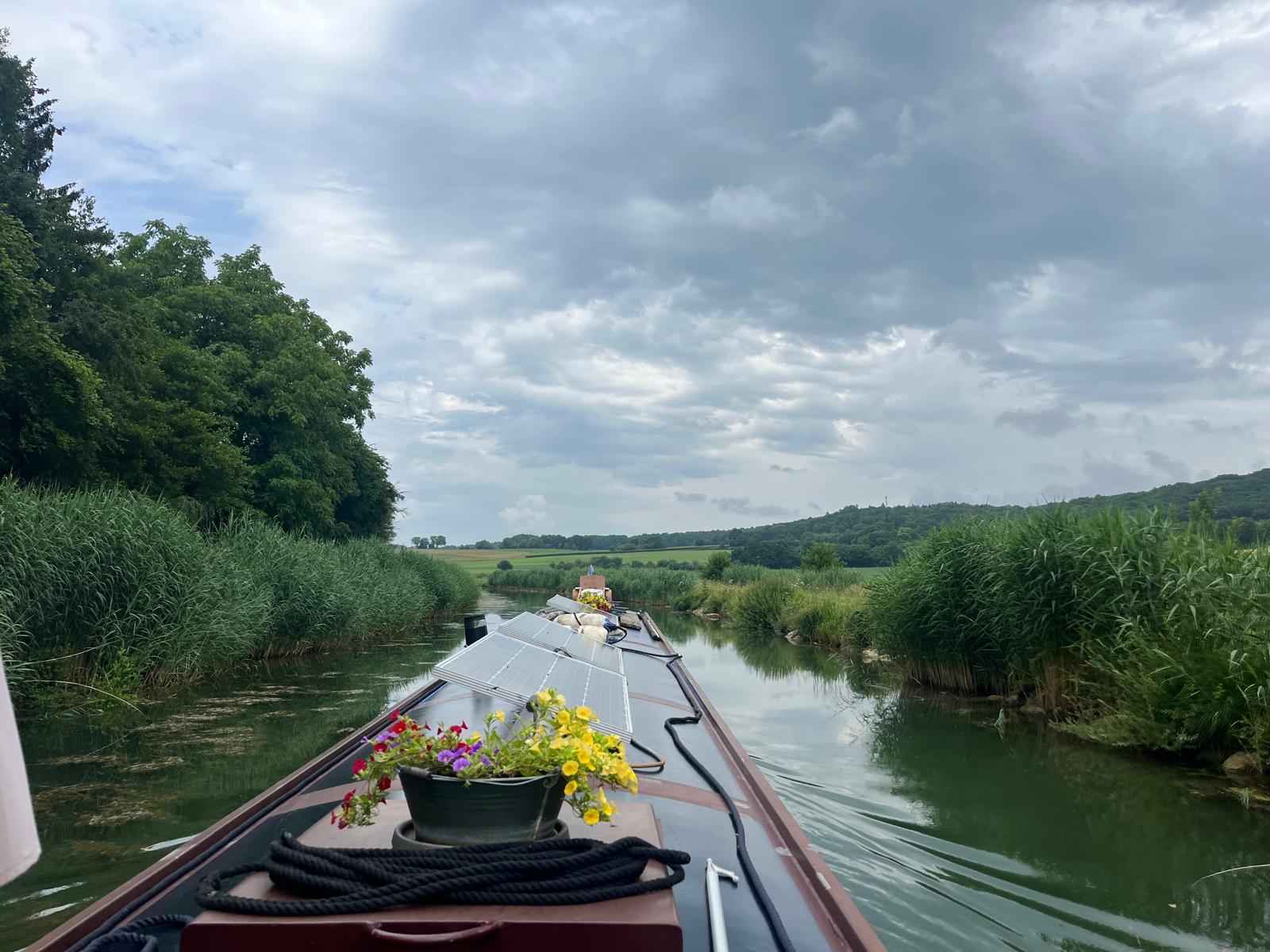
hour away. The first section of canal we went along was looking very much like an English canal in
places.

We soon joined a section of the river Allan and after a
kilometre or so we were approaching the first lock that would be operated by
our éclusier for the day. A tributary of the Allan, the Bourbeuse joined at the
lock which made an interesting junction as the lock entrance was between the
two rivers. We’d obviously made ourselves clear as to what time we were
travelling as our éclusier was getting the lock ready when we arrived.

It was from this point that we’d be leaving the Allan valley as the canal then follows the Bourbeuse valley up to the summit. When we were travelling up from Montbéliard yesterday we saw a party of schoolchildren cycling with their teachers. We saw the same group a couple of hours or so later and were amazed at how long they were cycling in the heat but I suppose they’re used to it. While going up the next lock we saw another group of children, most were taking a rest in the shade but came to the side of the lock or stood on the lock gates to watch us going up.

Soon after the third lock, our éclusier saw us through a swing
bridge in a village called Froidefontaine where we were hoping to moor.

We pulled up just after the swing bridge in front of a boat
that looked like it hadn’t moved for a long time, in fact, checking the licence
later it had run out over five years previously.

The cycle path next to the mooring is still the Euro Velo 6 cycle
route that’s been running alongside us since we joined the canal at its start 180
km ago. That length is a drop in the ocean compared to the full length of the
cycle route at 4,450 km from the Atlantic to the Black Sea.
We didn’t fancy walking far in the heat but as the next
village, Charmois, was only a couple of kilometres away we paid it a visit during the afternoon. It didn’t have an old church probably because there were very
few old houses in the village but it did have a war memorial

And a lavoir with running water.

We also wandered over to the church next to where we were moored and found that much of the church dated from the 12th century as a priory and the large building next to it had the date 1720 on its lintel.

Whilst walking to and from Charmois we'd noticed quite a few storks either flying in the thermals or pecking at the ground in a freshly mown hayfield. It wasn't until we got back to our village that Karen noticed a stork nest practically next to our boat. It had been built on a support erected for the purpose and there were two young in the nest waiting for the return of their parents with some food.

Having said we haven’t heard cuckoos since the beginning of June we heard one calling later once we were back on board. This reminded us of a saying that we’d never heard of before until Mavis, a dear friend of ours from our village told us:
“The cuckoo comes in April, he sings his song in May, he changes his tune in the middle of June & then he flies away.”
On Friday we cruised 7.5 km up three locks, through one
swing bridge and saw one boat, a French river cruiser that came out of a lock
as we went in.
SATURDAY 21 JUNE
We set out at 10.00 as agreed with our éclusier on Friday
expecting him to be setting the first lock for us when we arrived. We were a bit
surprised when we could see the lock in the distance but no white van next to
it which would have indicated the presence of an éclusier. Even though we’d
been told that the remaining locks on the canal aren’t automatic, we tried the
télécommande and for our second surprise found that it worked. In fact, it
worked for all three locks of the day and we never saw our éclusier. Maybe they
just wanted to know when we were moving so that they could provide cover if we
had a problem.
We’ve been noticing a distinct lack of walnut and plane trees
for the last few days and saw none on the journey. Coupled with that, the woodland
scenery was just like being in the UK with oak, ash, sycamore, white willow and
hazel being the predominant trees; the planes and walnuts make such a
difference when they are absent. Passing a field that was being tedded we counted
20 storks in close proximity. We’ve never seen more than a handful together
before so wondered what was going on. A friend suggested they may have been
gorging on insects that would have been disturbed when the hay was being tedded.
The morning started quite hazy which we thought would provide
a welcome relief from the heat but by mid-morning the clouds had burnt off and
we could see the Black Forest mountains in the distance as we cruised along.

When we came out of the third lock we’d reached the summit and
were in a village called Montreux-Château which is where we’d planned on stopping
for the day. There were quite a few boats at the moorings but most were either liveaboards or abandoned with just a couple that were cruising like us. We slotted
in next to a borne which was handy as we could top up with water and do some
washing. A French guy from the boat behind came up to tell us that the bornes weren’t
working but we decided to stay anyway as it seemed a pleasant spot.

There was also a péniche on the moorings that had been converted to a restaurant. We wandered down to have a look but found it was fully booked for lunch and dinner. After a quick rest we walked into the village and immediately came across the mairie which looked very pretty with flowers dotted around it. The war memorial stood directly in front of it.

Opposite the mairie was a lavoir with a sign saying it was built
in 1875 and that the building is part of the village’s heritage so must be treated
with respect. A second sign supported this by indicating that bicycles were not
permitted in the vicinity of the building. I suppose that being on the cycle
route it would seem an ideal place for cyclists to stop and sit on the washing
stones for a rest in the shade.


We’d noticed that when we’d come through the top lock before the summit, it was number three so wondered what had happened to numbers one and two. Looking at maps we found that the current summit was lower than the original and the two locks had been bypassed and also one at the other end of the summit level. This was clearly something I wanted to see even though it was too hot to be walking far. Karen stayed behind in the shade while I went to find the disused locks. I did find them, or at least where they were but couldn’t get anywhere near them because the sides were covered in nettles.

While I was out, an éclusier called by the boat to remind Karen we’d agreed to be at the first lock by 9.00 on Sunday morning. He also explained that the boat behind us would be travelling with us down the 15-lock flight to Dannemarie.
On Saturday we cruised 6.5 km up three locks and saw no
boats.
SUNDAY 22 JUNE
We left at ten past eight on Sunday morning to make sure we
got to the top lock of the flight down to Dannemarie by 9.00, the time we’d agreed
with VNF. Our French neighbours were leaving 20 minutes later as they had a
river cruiser so wouldn’t take long to catch us up. We’d had a conversation
with them before we left to agree who would go first into the locks. They were
happy when I said it’s best if we went first. When we arrived at the lock it
was already set for us and there were six éclusiers and one éclusiere milling
around; here are some of them…

…and Karen giving information to another

You may have noticed the tray of fruit on the hatch cover in
the picture above. Before we’d left Karen had moved our walnuts onto the second
stage of the pickling process by removing them from the brine they’d been in
for eight days and laying them out on trays. This stage turns them black in the
sun and should only take one or two days because there's so much sun at the moment.

When the sun beats down while we’re cruising, we put the
parasols up between locks and, so far, we’ve not forgotten to drop them when we
go into a lock. With the locks so close together we had to negotiate the whole
flight with the parasols down to avoid any chance of an accident. We ended up
with two éclusiers seeing us down the flight in their vans. They alternated
locks but stopped for a chat each time they passed each other.

When we were near the bottom of the flight our éclusier
asked us and our French friends for a bowl. We each gave him a colander and he
disappeared around the back of the lock cottage. After a while he reappeared
with both colanders full of redcurrants and handed them back to us. At the final
lock Karen noticed a heron standing watching the water level drop. We’ve seen
this behaviour before as they watch for fish getting stranded on the cill as
the water drains out. As expected, it did spot a fish and we saw it fly down to
pick it up. I managed to get a shot as it got ready to fly into the lock.

As we came out of the lock we were immediately in the port of Dannemarie and moored opposite using a couple of handy commercial bollards.

Karen went over to the port to check where and how we could get water. The office had closed for the day so we’ll have to go over when they open in the morning. We had a nice long lunch at a restaurant overlooking the port and spent the rest of the day on and around the boat alternating between listening to the first test between England and India and dozing.
On Sunday we cruised 10 km down 15 locks and the only boat
we saw was the French couple we locked down with.
MONDAY 23 JUNE
Monday was forecast to be windy with temperatures dropping
just below 30°C before they
climb again during the week. It was definitely gusty when we got up so we
decided to stay put for the day. It still felt very warm meaning we took it
easy and just had a couple of short walks during the day. Thinking about it
that was a bit unfair on Karen as she’d already been for a long early morning run.
Our walk before lunch took us further along the canal past
the next couple of locks. Karen had spotted a couple of walnut trees at the
second one so we went equipped with a bag and some gloves as Karen wanted to
start pickling another batch of green nuts. There were a couple of pill boxes
at the first lock of a type we’d never seen before.

We harvested the nuts we needed when we reached the second
lock and felt it was too hot to continue in comfort so we turned around. On the way back we
called in at the port to see Rob and Amy on Vivante whom we first met in
Besançon. They’d left their boat in the port while they went to Strasbourg for a
break for a few days and had just returned. In the afternoon we walked into Dannemarie
and rather than finding a village as expected it was actually a town. It was
definitely very Germanic and even the street names were bilingual.


The mairie had the words ‘RATHAUS’ and ‘TOWN HALL’ under the words ‘HOTEL DE VILLE’ and also had a very prominent stork’s nest on its chimney stack.

The sun had done its job and turned the walnuts in their trays black as expected which meant they were ready to be put into pickling jars with some malt vinegar based concoction that Karen made in the afternoon. She also got the green nuts we picked in the morning into the first stage of the process.
Next week will see us getting to Mulhouse which sits at the end of this canal. We’ll then join the canal de Huningue down to the Rhine and have to get used to the big locks and boats up to 180 metres long for the first time this year.